The Famous Bridge in Ronda, Spain: Must-See Wonder
You’re standing on the edge of a cliff in a little hilltop town in southern Spain. Below you — like, far below you — a river winds through a dramatic rocky gorge. And right in front of you is a centuries-old stone bridge that looks like it was literally carved out of the mountain itself.
That’s Ronda. And that bridge? That’s the Puente Nuevo. And yes, it’s every bit as insane as it sounds.
What Even Is Puente Nuevo?
So “Puente Nuevo” means “New Bridge” in Spanish. Which — okay, it’s over 200 years old, so the name is a bit of a stretch — but fine, we’ll let it slide.
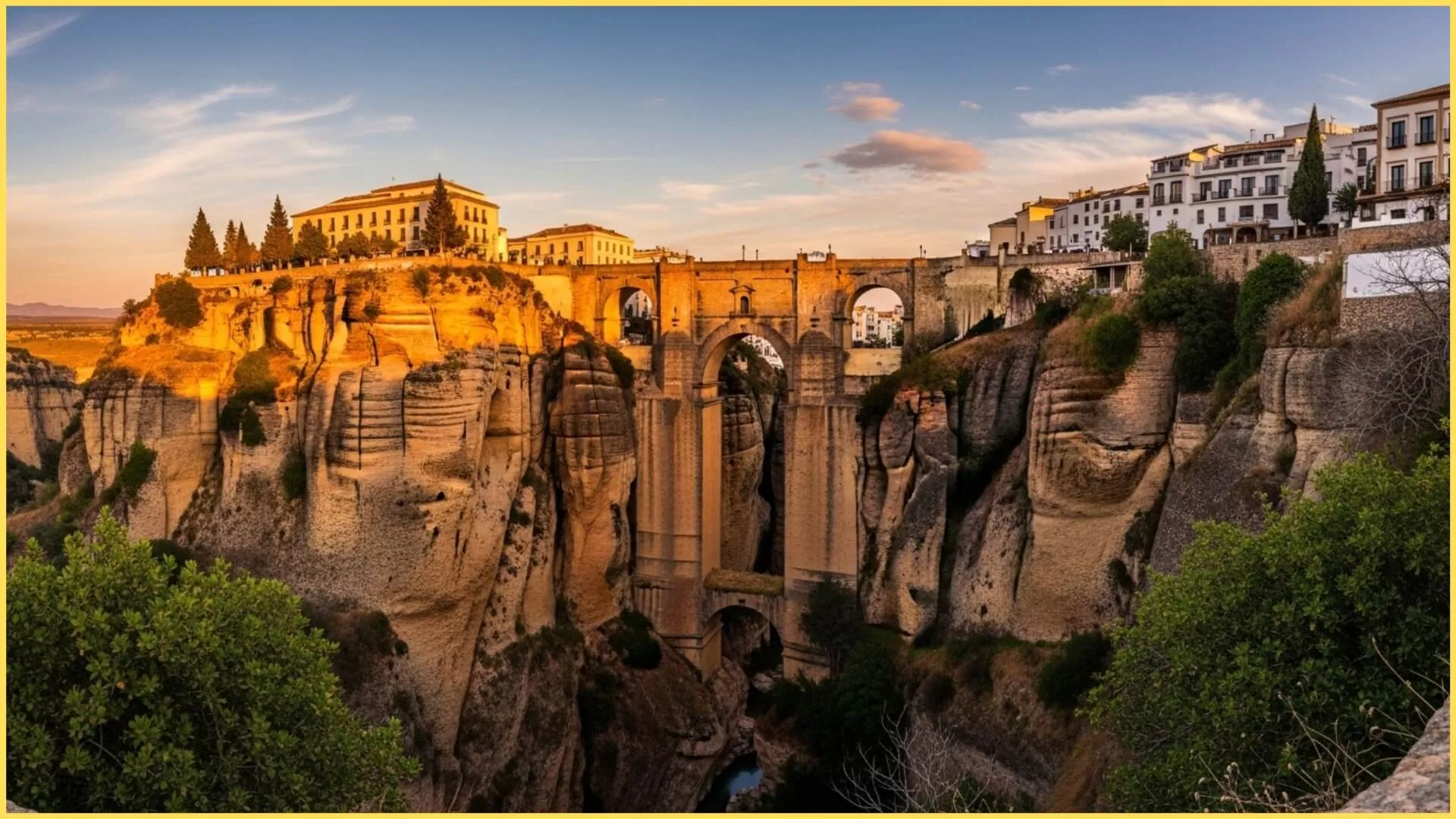
The bridge connects Ronda’s ancient Moorish old town with the newer part of the city, straddling a gorge called El Tajo. And when I say gorge, I mean a 120-metre drop straight down to the river below. Standing on it and looking down is one of those moments where your stomach does a little thing, and your brain just goes “…wow.”
It’s widely considered the most famous bridge in Spain. Once you see it, you’ll get it immediately.
A Bit of History (The Fun Stuff Only)
Building started in 1751 and took over 40 years to finish, wrapping up in 1793. The architect was a guy named José Martín de Aldehuela, who clearly had zero interest in doing anything small-scale.
Fun fact: they actually built a bridge here before this one. It collapsed after just six years. So version two was kind of a “let’s not mess this up again” situation — and they absolutely nailed it.
Oh, and here’s the wildest detail: that hollow chamber inside the central arch? Originally used as a prison. Later, it became a café (very on-brand for Spain), and now it’s a little museum about the bridge’s history. Definitely worth a quick visit.
The Design Is Genuinely Stunning
Even if you’re the kind of person who usually speed-walks past historical monuments, this one will get you. The whole bridge was built using stone from the gorge itself, which is why it looks like it grew right out of the cliffs. It doesn’t feel placed there — it feels part of the landscape.
The big central arch is the showstopper. It spans the full width of the canyon and holds the whole thing together in a way that still feels almost unbelievable for the 1700s. Honestly impressive stuff — and it’s held up way better than a lot of modern construction, so make of that what you will.
Where to Get the Best Photos
Let’s be real — half the reason people visit Ronda is for the photos. And the good news is, you basically can’t go wrong. But here are the top spots:
Mirador de Aldehuela — The classic postcard view. This is the shot. Go early morning for the best light and minimal crowds.
Puente Viejo (Old Bridge) — Head down to the older bridge for a lower angle that puts the Puente Nuevo in full perspective. Really cool shot that most tourists miss.
El Tajo Gorge trails — If you’re up for a bit of a hike, the gorge paths give you angles that feel totally exclusive. Worth the leg workout.
Sunset from the clifftops — Golden hour in Ronda is genuinely magical. Warm light, dramatic shadows, stone glowing orange. Bring your camera. Or just your phone. You’ll be happy either way.
What Else Is There to Do?
Good news — Ronda isn’t just a one-bridge town. There’s plenty to keep you busy:
Wander the old town — Narrow cobbled streets, whitewashed houses, little squares that feel frozen in time. Genuinely lovely for just aimless wandering.
Check out the Plaza de Toros — One of the oldest bullrings in Spain. Even if that’s not your scene, the architecture is beautiful, and the museum inside is actually really interesting.
Hike the gorge — The trails down into El Tajo give you a completely different perspective on the whole landscape. Not too difficult, and the views back up to the bridge are incredible.
Eat something good — Ronda’s food scene is seriously underrated. Try the rabo de toro (braised oxtail), berenjenas con miel (fried aubergine with honey), and a glass of local wine. You’re welcome.
Quick Tips Before You Go
A few things to know so your visit goes smoothly:
Skip summer if you can. July and August in Ronda = hot, crowded, sweaty. Spring (April–June) or autumn (September–October) is way better — perfect weather, way fewer people.
Get there early. The main viewpoints fill up fast, especially on weekends. If you’re there before 9 AM, you might almost have the place to yourself.
Wear comfortable shoes. I cannot stress this enough. The old town is all hills, steps, and uneven cobblestones. Your feet will thank you for sensible footwear.
Stay the night if you can. Day-trippers totally miss out. Ronda after dark — with the bridge lit up, and the gorge swallowed in blackness below — is a completely different and honestly better experience. It’s really something special.
Why You Should Absolutely Visit
Here’s the thing about the Puente Nuevo — it’s one of those rare places that actually exceeds the hype. You know how sometimes you build something up in your head and then it’s just… fine? Yeah, this is the opposite. You get there, and it’s even more dramatic in real life than in any photo you’ve seen.
It’s got everything: history, jaw-dropping engineering, insane natural scenery, and that feel-good sense of being somewhere truly special. Whether you’re a photography obsessive, a history nerd, or just someone who wants to stand on a bridge and stare into a massive gorge, Ronda delivers every single time.
The Puente Nuevo isn’t just a bridge. It’s a whole mood. It’s history and beauty and “holy wow” all rolled into one stone arch hanging over a canyon in the hills of Andalusia.