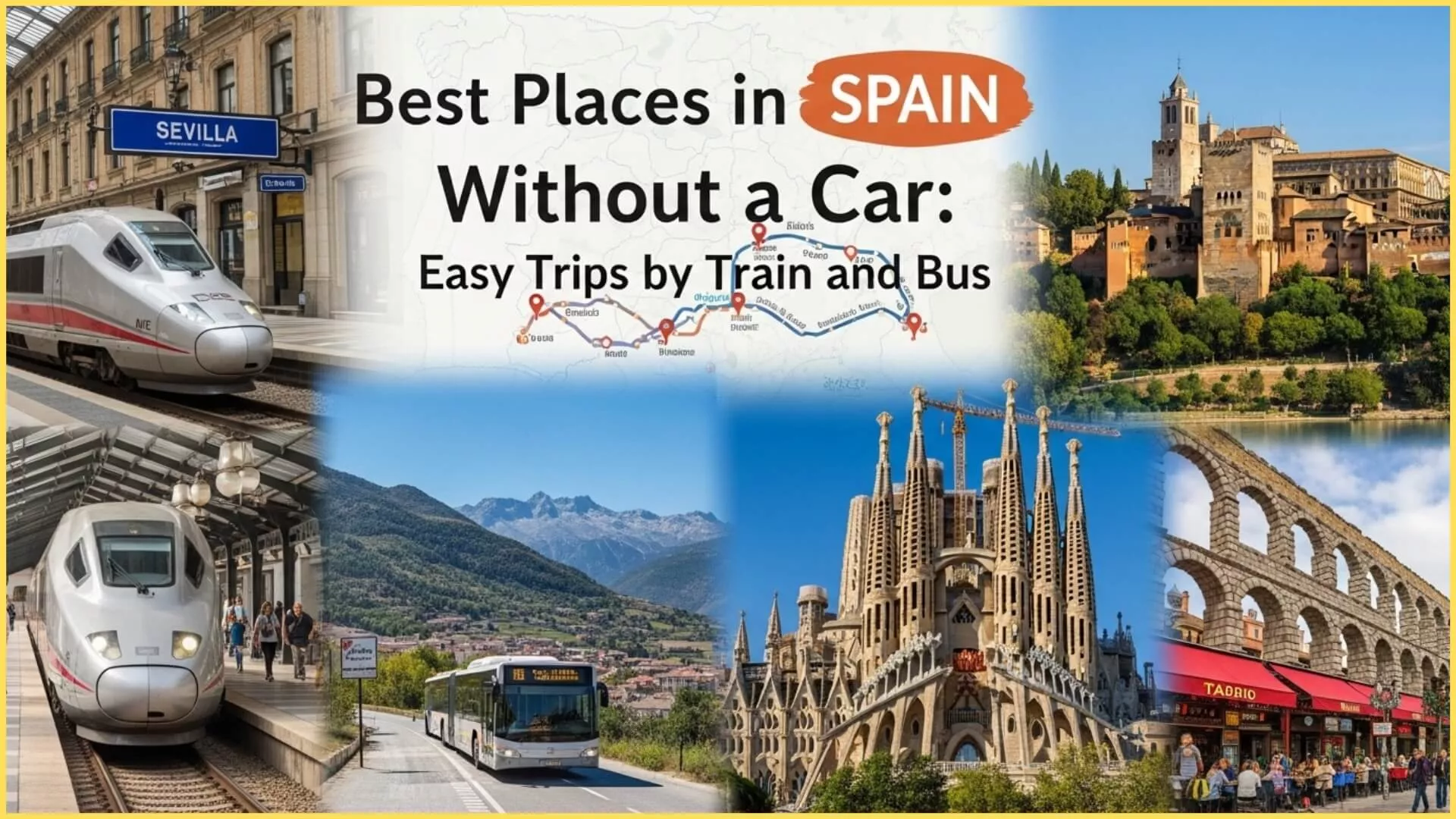
Best Places in Spain Without a Car: Easy Trips by Train and Bus
Spain is honestly a dream if you want to travel around without driving. You do not need a rental car, you do not need to stress about parking, and you definitely do not need to argue with Google Maps in a random village. Spain has the longest high-speed rail network in Europe, making getting between major cities fast and surprisingly easy.
The AVE high-speed trains connect big cities like Madrid, Barcelona, Valencia, Seville, and Córdoba, and for the places trains do not reach directly, buses usually fill the gap pretty well. That means you can plan a full trip using trains, buses, your feet, and maybe one coffee stop too many.
Why Spain Works So Well Without a Car
The main reason is simple: the transport network is strong. Spain’s high-speed rail network stretches to about 3,973 km, which is more than anywhere else in Europe, so the big city-to-city routes are usually quick and comfortable.
And when the AVE does not get you all the way there, regional trains and bus companies usually do the rest. This is especially helpful for beach towns, smaller historic cities, and places like the Costa Brava, where a train-plus-bus combo is often the smartest way to go.
What Makes a Place Easy Without a Car
Not every destination in Spain is equally easy without wheels. The best no-car places usually have direct train access or frequent buses from a major city, plus a walkable center where you can do most things on foot.
It also helps if the place is compact and does not need loads of local transport once you arrive. Basically, if you can step off the train, walk into the old town, and start sightseeing without needing a taxi, that is a very good sign.
Best Base Cities
Madrid
Madrid is probably the best base in Spain for car-free travel. From Madrid, you can do easy day trips to places like Toledo and Segovia by fast train, and both routes are very quick. Madrid to Toledo takes about 34 minutes, while Barcelona to Girona can be as fast as 38 minutes on high-speed services, which gives you a good idea of how efficient these routes can be.
What makes Madrid especially useful is that you can stay in one hotel and still see a lot without moving around too much. That is always a win, especially if you are not in the mood to drag a suitcase over cobbled streets every other day.
Barcelona
Barcelona is another excellent base if you want easy train trips and a mix of city, culture, and coast. High-speed trains make Girona a super easy hop, with the fastest journeys taking around 38 minutes, and Figueres is also on the same corridor.
Barcelona is also handy if you want to reach the Costa Brava without driving. The usual trick is simple: train to Girona or Figueres, then bus onward to the beach towns. It sounds like a tiny bit more effort, but in practice, it is very doable.
Seville
Seville is a great base for exploring Andalusia without a car. It works especially well if you want to combine Seville, Córdoba, and Granada in one trip without dealing with road trips or parking drama.
Córdoba is one of the easiest add-ons from Seville because the rail connection is fast and simple. Granada takes a bit more planning, but it is still very doable by public transport, and many travelers find the bus from Seville easier than trying to force a rail connection that is not as direct.
Valencia
Valencia is a strong option if you want a coastal city base without renting a car. It gives you a nice mix of beach vibes, city life, and solid transport links along the Mediterranean side of Spain.
It also works well if you want to continue south toward Alicante or nearby coastal spots. So if your dream trip is more sea, sun, and less steering wheel, Valencia makes a lot of sense.
Best Places to Visit Without a Car
Toledo
Toledo is one of the easiest and most rewarding day trips in Spain. The train from Madrid takes about 34 minutes, and once you arrive, the historic center is the main event anyway, so walking is part of the fun.
It is perfect if you like old streets, huge historic buildings, and that “wow, this place looks like a movie set” feeling. If you only do one easy day trip from Madrid, Toledo is a very strong choice.
Segovia
Segovia is another top pick from Madrid. It is famous for its Roman aqueduct, compact old town, and easy sightseeing layout, which makes it ideal if you want a simple day trip with no transport headache.
It is the kind of place where you can arrive, walk around for a few hours, eat well, and leave feeling like you actually saw a lot. No car, no hassle, no need for military-level planning.
Córdoba
Córdoba is one of those cities that gives you a lot without needing much time. It fits very nicely into a southern Spain route because it sits on a major rail corridor, and the main sights are close enough together to explore on foot.
That makes it perfect for either a day trip or a short stop between bigger cities. If you like places that feel high-value with low effort, Córdoba is a great shout.
Granada
Granada is absolutely worth the trip, even if it is not quite as effortless as Toledo or Girona. You can reach it by direct train from some big cities, and from Seville, many people choose the bus because it is often simpler and more practical.
Once you get there, the city itself is very walkable in the main areas. Just one important tip: if you want to visit the Alhambra, book early, because waiting until the last minute is not the move.
Girona
Girona is one of the easiest and nicest trips from Barcelona. The fastest trains get there in about 38 minutes, and the old town is close enough to reach on foot without turning the day into a mission.
It is also extra useful because Girona works as a gateway to the Costa Brava. So you can enjoy the city itself or use it as a jumping-off point for beach towns by bus.
Figueres
Figueres is best known for the Dalí Theatre-Museum, and it is another simple train trip from Barcelona on the same high-speed line. That makes it a good option if you want something a bit different from the usual city break routine.
It also works as a practical hub for the northern Costa Brava. So if you are trying to explore that part of Catalonia without a car, Figueres is more useful than many people realize.
Tarragona
Tarragona is a really nice option if you want history and a bit of beach in the same trip. It is easy to reach from Barcelona, and the Roman sites and seaside feel make it a very fun mix.
It is one of those places that does not always get as much attention as it deserves. But for an easy no-car stop, it is a very solid pick.
Alicante and Benidorm
If you want sunshine and a beach without renting a car, Alicante and Benidorm make a good pair. Alicante is easy to reach by train, and from there, public transport helps you continue along the coast.
This combo works especially well for travelers who care less about museums and more about sea views, promenades, and taking it easy. Which, to be fair, is a pretty valid travel style.
Best Regions for a No-Car Trip
Madrid and Central Spain
This is probably the strongest region in Spain for car-free day trips. Madrid gives you access to places like Toledo and Segovia very quickly, and that makes it ideal if you want variety without changing hotels all the time.
It is also great for first-time visitors because the planning is easy. You can basically pick one city each day and go. Very low stress, very high reward.
Andalusia
Andalusia is one of the best regions in Spain for a no-car route, especially if you focus on Seville, Córdoba, and Granada. These cities combine really well and give you a strong mix of history, food, architecture, and atmosphere.
A simple version of the trip would be Seville first, Córdoba as a day trip, then on to Granada. It is a classic route for a reason — it just works.
Catalonia
Catalonia is also excellent without a car if you stick to the main rail corridor. Barcelona, Girona, Figueres, and Tarragona are all easy to combine, and the transport setup is pretty straightforward.
For the Costa Brava, the smart move is usually not to force a direct trip from Barcelona to every beach town. Instead, go by train to Girona or Figueres and then connect by bus. That is usually the easiest no-car strategy.
Places That Are Harder Without a Car
To be fair, not every part of Spain is super easy to get to by public transport. Some beautiful places are reachable, but they need more patience, more planning, or both.
A few examples:
- Ronda and the surrounding mountain areas can be tricky once you want to move beyond the town itself.
- Rural Extremadura is harder because connections are thinner and more spread out.
- Pyrenean villages can be stunning, but public transport is limited.
- Parts of the inland Costa Brava are possible by bus, but schedules can be patchy outside summer.
Tips for Traveling in Spain Without a Car
A few things make the trip much easier:
Use high-speed trains for the big routes whenever possible, because they save time and are usually very comfortable.
Use buses for smaller towns, beach areas, and places that trains do not reach well.
Pick one base city and do day trips instead of changing hotels constantly.
Book popular train routes early if you are traveling in busy periods, because prices usually go up.
Stay near the station or near the old town if you can, because it makes everything easier on arrival.
FAQ
Is Spain easy without a car?
Yes, very much. Spain’s rail system is excellent for major routes, and buses help cover the places beyond the main train lines.
Which city is best for day trips without a car?
Madrid is probably the strongest overall base. It gives you easy access to several classic day trips without much effort.
Can you visit Andalusia without driving?
Yes, definitely. Seville, Córdoba, and Granada are all very doable by train and bus.
Is Barcelona good for car-free travel?
Yes. It is one of the best bases in Catalonia for train trips and train-plus-bus connections to the coast.
When is the bus better than the train?
Usually, when you are heading to smaller towns, coastal spots, or places like Granada from Seville, the bus can be simpler. It is also often the better option for Costa Brava towns after you reach Girona or Figueres.